 SemanticExcel
For researchers in psychology, health and the social sciences
Statistical analysis of text, in a spreadsheet
Put your participants' words or texts in a column. SemanticExcel turns them into numbers with a language model and runs the tests: similarity, t-tests, correlations, predictions and word figures. No programming.
| A | B | C | |
|---|---|---|---|
| 1 | Words: describe your life | HILS | Harmony similarity |
| 2 | calm, balance, family, peace, content | 31 | 0.62 |
| 3 | stressed, busy, tired, worried, alone | 14 | 0.18 |
| 4 | friends, work, music, hopeful, free | 26 | 0.47 |
| 5 | conflict, money, chaos, angry, lost | 9 | 0.11 |
What you can do
Five analyses, each one menu choice
Every analysis works on whole columns of text and gives results you can report in a paper. The manual shows each one step by step.
Semantic similarity
A score for how similar each text is to another text or to a norm, such as harmony in life.
Semantic t-test
Tests whether two sets of texts differ in meaning, paired or unpaired.
Semantic-numeric correlation
Trains a model from texts to a rating scale and reports the cross-validated correlation.
Prediction
Applies a trained model to new texts, for example to estimate depression or well-being.
Word figures
Plots the words that differ significantly between groups or along a scale, with Bonferroni or Holm correction.
Language models
Any model on Hugging Face, or a classic space
Choose a model when you create a document or import a sheet.
- Hugging Face transformer models are the default. Pick one from the recommended list or search huggingface.co for another, including multilingual models.
- LSA spaces exist for 14 languages, from English and Swedish to Portuguese and Chinese.
- A model is downloaded to the server the first time it is used. That can take a few minutes.
SemanticExcel in 12 seconds. The video repeats.
Word figures
See which words carry the difference
Participants described pictures of happy, sad and contemptuous faces in their own words. The figure places each word by how typical it is for the sad pictures, compared with the happy and contemptuous ones. Large words are frequent, and colored words differ significantly after Bonferroni correction.
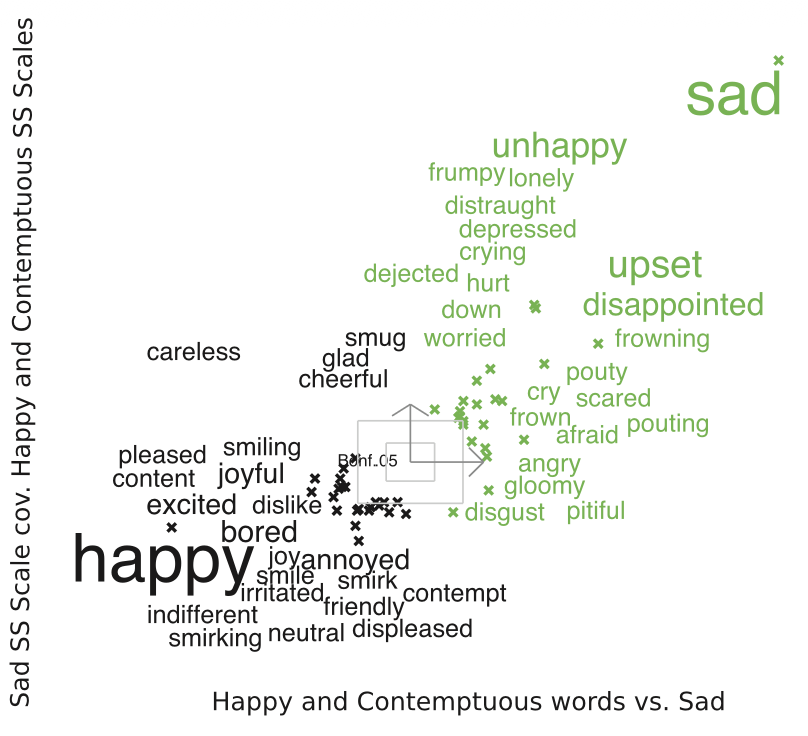
From Kjell, Kjell, Garcia & Sikström (2019), Psychological Methods 24(1), 92–115. doi:10.1037/met0000191.
Open library
Measures you can cite and reuse
The SemanticExcel Library collects norms and trained models with a datasheet: what they measure, how they were made and how they were validated. Every version keeps its own citation.
Harmony in life 2018
Norm from 120 participants' descriptions of harmony in life.
r = .43 with the Harmony in Life ScaleSee the datasheetDisharmony with life 2018
Norm from 96 participants. Use it with the harmony norm as a bipolar scale.
bipolar r = .65 with the HILSSee the datasheetPublish a norm or a model
Share a measure from your own study. An editor can review it for level 3, Validated.
How publishing worksPublications
34 peer-reviewed articles since 2018 and the book Statistical Semantics (2020).
See the listContact
Questions, errors or ideas
Report an error, suggest a publication, join the development or sign up for a workshop. We answer by email.